The board games people keep playing are rarely the ones with the longest rulebook. They are the ones a second person can learn before the first game is over, finish without checking the time, and still want to reset. Short does not mean shallow. It means the interesting decision shows up early.
If you are choosing a game for a kitchen table, a lunch break, or a visit with someone who does not own a shelf of boxes, start with the session, not the theme. Ten to twenty minutes is enough for a real match. Forty minutes is already a commitment. Anything past that needs a group that asked for a long game.
What a short game has to do
The goal fits in one sentence. If you need a paragraph, the first game will be a lesson, not a match.
A turn is a single clear action: drop a disc, move a piece, sow seeds, make one capture.
Someone can lose and see why. Hidden information and long combo chains make a loss feel like a trick.
Resetting takes seconds. The second game is where people actually start to play.
The better player wins more often than not, but a newcomer can steal a game.
That last point is the one people skip. A game that only the teacher can win becomes a demonstration. A game that is pure luck becomes a coin flip with extra pieces. The classics that survived did both jobs: they are kind to a beginner and still strict with someone who has played a hundred times.
Five classics, and the job each one does
These are not a shopping list. They are five different answers to “we have a little time.” You already know some of them. The useful part is knowing which mood each one fits.
Connect Four
Drop a disc. It falls to the lowest open space in that column. Get four in a row, horizontal, vertical, or diagonal. Most people can play the first game with no teaching beyond that sentence. The skill is seeing a threat one move before it lands, and noticing that your own winning move just handed the opponent a win on the next turn. It is the right game when the group includes a child, a guest, or anyone who will leave if the explanation takes longer than the match.
Checkers
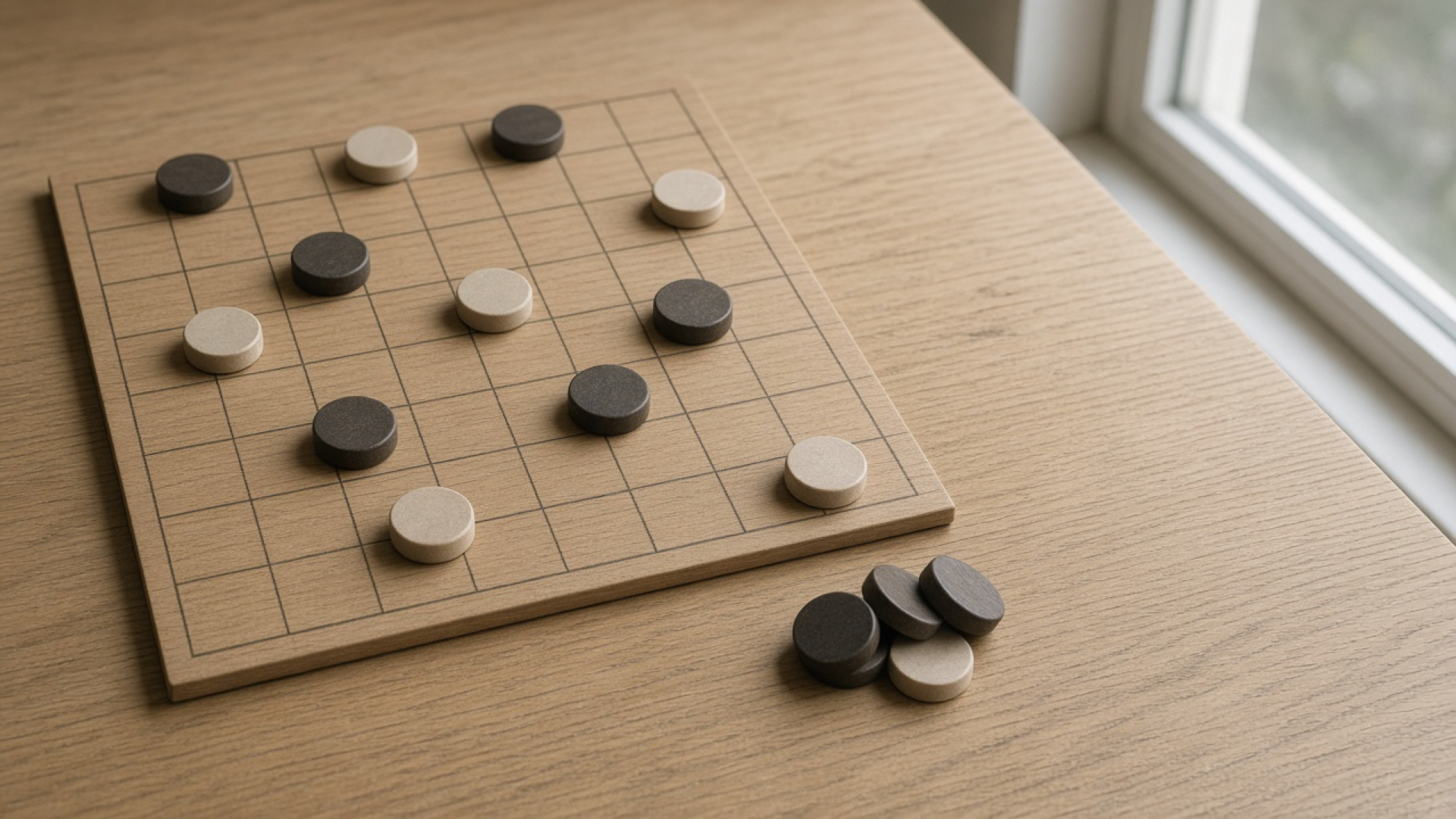
Checkers asks for a longer attention span and pays it back. Pieces move forward on the dark squares. A jump captures. A piece that reaches the far side becomes a king and can move both ways. The game is about forcing a jump, not about the jump itself. It suits two people who want a quiet rivalry and do not mind that the first few games will be lopsided. Once both players see forced captures, the matches get sharp.
Alquerque
Alquerque is older than checkers and less famous, which is why it surprises people. Each player starts with twelve pieces. A move is one step along a marked line to an empty point. A capture jumps an adjacent opponent and continues when another jump is there. Because pieces can move in more directions than in checkers, the board opens up faster and a single careless piece can be chased across the grid. Choose it when both players already like capturing games and want something they have not memorized.
Mancala
Mancala, in the common two-row form, is sowing: pick up the seeds in one pit and drop them one by one into the following pits, including your store. The rules of capture change by region, so agree on one version before you start and do not switch mid-game. It is a good choice when you want a game that feels rhythmic rather than like a hunt. New players can make a legal move immediately. Better players are counting the lap that lands in their store and earns another turn.
Backgammon
Backgammon is the short game that includes luck on purpose. Dice decide how far you move. The board decides whether that roll is useful. Hitting a blot, building a prime, and bearing off are the three ideas that matter. It is the right pick when people want conversation and a result in the same half hour, and the wrong pick when someone will be angry that a die changed the match. If you play it, use the same doubling habit every time or do not use the cube at all until everyone has asked for it.
Teach the goal, play one imperfect game, then play the real one. The rulebook is not the evening.
Match the game to the people, not the box
One of you has never liked board games: Connect Four or mancala. Stop explaining and start.
You both want to improve at the same game: checkers or Alquerque. Keep the same rules for a month.
You want luck in the room so a win does not feel like a lecture: backgammon.
You only have ten minutes: Connect Four. A checkers game that gets abandoned teaches nothing.
Children and adults are mixed: use the game whose capture rule a child can enforce without an adult overruling them.
How to teach without ruining the first game
Set the board up before you speak. Point at the goal. Play the first three turns slowly and name the action, not the strategy. “This disc falls. Four in a line wins.” Save the traps for the second game, and only mention one. People remember a single stolen win. They do not remember six warnings.
Also decide draws and illegal moves out loud. In Connect Four, a full board with no four is a draw. In checkers, if you can jump you must jump, if that is the rule you are using. In mancala, name what happens when the last seed lands in your store. Ambiguous rules do not create interesting games. They create arguments.
Why these games are still worth a table
A short classic survives because the position stays readable. You can look at the board and talk about it. You can reset it. You can play it with pieces that are not the official ones: coins, stones, a paper grid. That is a different pleasure from a game that only works if every card and miniature is present.
It is also a useful test when you are making a game of your own. If a stranger cannot say the goal after one minute, the session will not be replayed, no matter how polished the pieces are. The old games are a standard, not a museum. Connect Four tells you whether your rules are teachable. Checkers and Alquerque tell you whether a capture is interesting on the tenth game. Mancala tells you whether a simple action can hide a real count. Backgammon tells you whether luck is part of the fun or an excuse.
How many games should we own?
Two is enough for most tables. One that anyone can learn tonight, and one you are willing to lose at for a while. A shelf of unplayed boxes does not make the evening better. A board that is already on the table does.
Are shorter games only for beginners?
No. Beginners need them because the rules fit in their head. Experienced players need them because a short game can be played seriously five times in an hour, and that is where the skill shows up. A long game hides a weak decision inside an evening. A short one puts it on the last move.
Maverick Codebase is a product studio. We design and ship native iOS and Android apps, mobile games, Laravel business systems, and the brands that hold them together.

Comments(00)
No comments yet. Be the first to join the conversation.